June 20, 2026
Engineering Enterprise Guardrails for Autonomous Agentic AI Workflows
A strategic blueprint for operationalizing agentic AI, enforcing deterministic safety boundaries, and orchestrating multi-agent tool execution in enterprise environments.
As enterprise technology teams transition from basic conversational LLM interfaces to autonomous Agentic AI workflows, the core challenge pivots from model capabilities to system governance, predictability, and safety.
When an AI agent is granted tool-calling access to execute API requests, query internal databases, or trigger cloud microservices asynchronously, non-deterministic LLM behavior becomes an operational risk. Building production-grade AI systems requires an architecture that surrounds probabilistic model reasoning with deterministic software guardrails.
The Multi-Agent Governance Model
Rather than relying on a single prompt to manage complex end-to-end workflows, production architectures decompose responsibilities into specialized agent roles governed by a central Orchestrator.
- Orchestrator Agent: Evaluates intent, decomposes requests into sub-tasks, and routes execution to specialized sub-agents.
- Specialized Worker Agents: Bound to strict, domain-specific schemas (e.g., Data Extraction, Financial Reconciliation, Audit Logging).
- Guardrail Interceptor Layer: Intercepts prompts, schema definitions, and API payloads before any backend tool execution occurs.
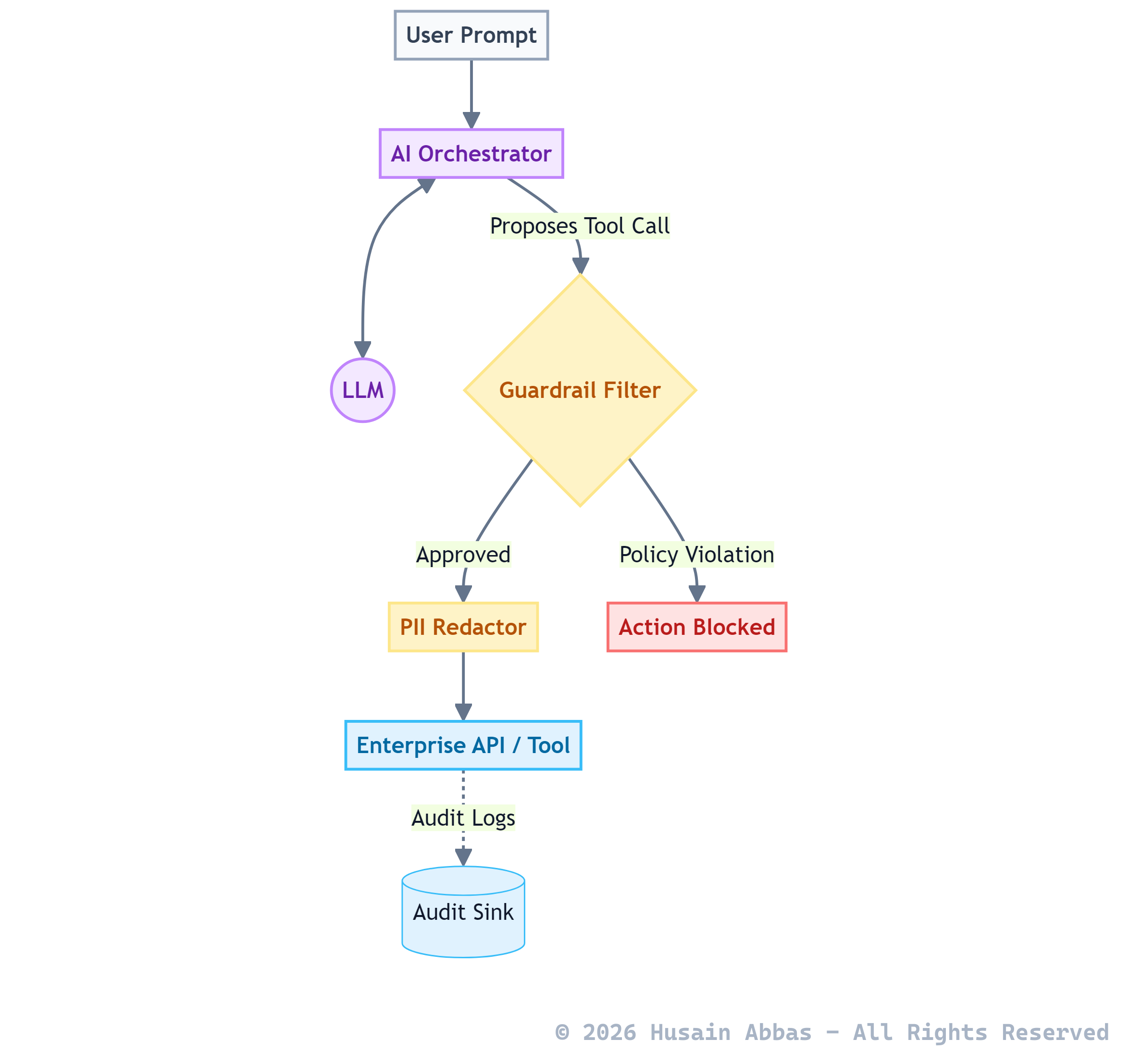
Deterministic Guardrail Implementation
To prevent unauthorized API access or hallucinated tool parameters, tool-calling interfaces must validate requests against strict JSON Schemas and execution constraints before reaching underlying microservices.
// Guardrail Interceptor Middleware
export async function executeAgentToolCall(
  toolName: string,
  params: Record<string, any>,
  context: ExecutionContext
): Promise<ToolResponse> {
  // Step 1: Prevent infinite loops (Runaway Agents)
  // If the agent keeps failing and retrying, we force a circuit break
  // to avoid massive token consumption and API abuse.
  if (context.currentDepth > context.maxAllowedDepth) {
    throw new Error(`Guardrail Triggered: Max agent loop depth (${context.maxAllowedDepth}) exceeded.`);
  }

  // Step 2: Enforce Deterministic Data Types
  // We grab the strict JSON schema required for this specific tool,
  // and validate the LLM's hallucinated parameters against it.
  const schema = getRegisteredToolSchema(toolName);
  const isValid = validateJsonSchema(schema, params);

  // If the LLM guessed the wrong parameter type, we reject execution immediately.
  // The agent receives the exact error so it can self-correct on the next try.
  if (!isValid.success) {
    return {
      status: 'REJECTED',
      reason: `Schema Mismatch: ${isValid.errors.join(', ')}`,
    };
  }

  // Step 3: Human-In-The-Loop (HITL) Check for High-Risk Actions
  // Actions like mutating a database or sending an email require manual review.
  if (schema.requiresHumanApproval && !context.isApprovedByHuman) {
    // Instead of failing, we pause execution and route to an approval queue.
    return await routeToHumanApprovalQueue(toolName, params, context);
  }

  // Step 4: Final Execution
  // Only if all guardrails pass do we actually touch the production microservice.
  return await invokeMicroservice(toolName, params);
}
Safety Boundaries & Rate Control
In addition to schema validation, robust agentic architectures enforce three operational boundaries:
- Circuit Breakers: Automatically halt agent execution loops if token usage spikes or if repeated tool execution failures occur.
- Micro-Segmented Access Control: AI agents interact through scoped API keys possessing minimum necessary permissions.
- Audit Telemetry: Log every agent decision tree step, parameter payload, and tool response to maintain full forensic traceability.
Key Architectural Takeaways
- Never grant raw database access to AI agents. Enforce zero-trust microservice boundaries.
- Decouple planning from tool execution. Intercept every tool call with deterministic schema validators.
- Implement circuit breakers on execution loops. Prevent infinite reasoning loops and unexpected token cost spikes.
- Require Human-in-the-Loop approval for high-risk commits. Automate read paths while protecting critical write operations.
Recommended Industry Reading & References
For further exploration of Agentic AI, safety boundaries, and autonomous systems, consider these authentic resources:
- HuggingFace Research: Open-Source AI Agents & Tools - Foundational concepts for building ReAct agents.
- OpenAI API Documentation: Function Calling & Structured Outputs - The gold standard for deterministic API enforcement.
- Harrison Chase / LangChain: Agent Architectures - Deep dives into multi-agent orchestration and routing.
- OWASP Top 10 for LLM Applications: LLM Security Best Practices - Crucial reading for enterprise AI security.
- Andrew Ng (DeepLearning.AI): Agentic Workflows - High-level conceptual breakdowns of how agents iteratively solve complex problems.