June 6, 2026
Hybrid Retrieval Architecture: Combining Vector Search with Knowledge Graphs for GenAI
How combining dense vector embeddings with structured graph retrieval solves hallucination and context bottlenecks in enterprise Generative AI deployments.
In enterprise Generative AI deployments, basic Retrieval-Augmented Generation (RAG) using raw vector similarity search frequently hits performance ceilings. Dense vector embeddings excel at semantic similarity, but struggle with precise relational reasoning, temporal accuracy, and multi-hop queries across complex corporate knowledge bases.
To achieve production-grade precision without hallucination, enterprise architects are transitioning toward Hybrid Retrieval-Augmented Generation, pairing vector search with Knowledge Graphs (GraphRAG).
The Limits of Pure Vector RAG
Standard vector databases slice unstructured documents into text chunks and perform cosine similarity search against prompt embeddings. In practice, this introduces two major bottlenecks:
- Context Fragmentation: Splitting long-form documents strips relational hierarchy, leading to incomplete or out-of-context retrieval.
- Precision Failure: Queries requiring exact entity relationships (such as “Which microservice dependency links component X to security policy Y?”) often return semantically similar text that fails to provide precise factual links.
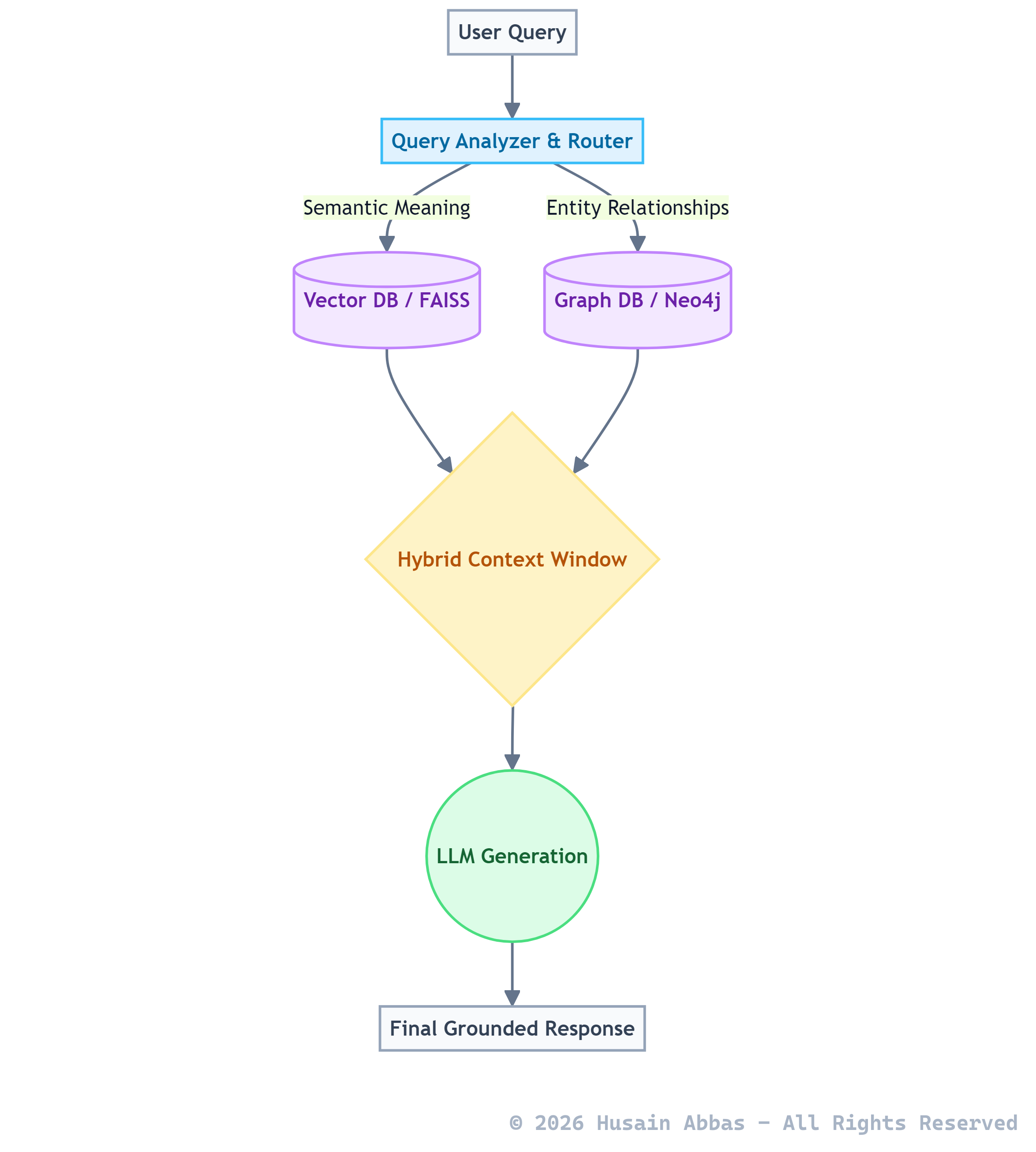
Dual-Index Hybrid Query Router
A hybrid retrieval engine unifies dense semantic search with structured graph traversal. The query processing pipeline routes incoming prompts across both indexes simultaneously:
// Dual-Index Hybrid Query Router
export async function executeHybridRetrieval(
  query: string,
  topK: number = 5
): Promise<RetrievedContext[]> {
  // Step 1: Parallel Retrieval across Vector & Graph Indexes
  // We fetch BOTH semantically similar text AND structured relationships simultaneously.
  const [vectorResults, graphResults] = await Promise.all([
    // Vector Search: Finds text chunks that "sound similar" to the query.
    vectorDatabase.search({ queryVector: await embedText(query), limit: topK * 2 }),

    // Graph Traversal: Extracts exact entities (e.g., "Policy Y") and finds connected nodes.
    knowledgeGraph.traverse({ entities: extractEntities(query), depth: 2 })
  ]);

  // Step 2: Combine and Deduplicate
  // We merge the raw text chunks and the structured graph relationships into a single candidate pool.
  const combinedCandidates = mergeResults(vectorResults, graphResults);

  // Step 3: Cross-Encoder Re-Ranking
  // A specialized model (Cross-Encoder) evaluates the exact relevance of each combined
  // candidate against the original query, bringing the most factual answers to the top.
  const rerankedContext = await crossEncoder.rerank({
    query: query,
    candidates: combinedCandidates,
    topN: topK
  });

  // Step 4: Return precisely grounded context to the Generative LLM
  return rerankedContext;
}
Benchmark Telemetry & Enterprise Impact
Combining dense vector search with Knowledge Graph traversal yields measurable performance improvements:
- Hallucination Reduction: Factual hallucination rates drop dramatically as the generation layer is grounded in explicit graph relationships.
- Multi-Hop Query Accuracy: Complex queries traversing multiple document hierarchies maintain full relational context.
- Auditability: Retrieved graph paths provide verifiable source attribution for enterprise compliance teams.
Key Architectural Takeaways
- Do not rely on pure vector search for structured enterprise data. Vector embeddings alone lack structural relational reasoning.
- Build automated GraphRAG pipelines. Extract entities and relationship triples during document ingestion to construct domain Knowledge Graphs.
- Employ Cross-Encoder Re-Ranking. Merge vector chunks and graph nodes, then re-rank candidate context payloads before feeding prompt templates to the LLM.
- Enforce explicit source attribution. Map generated outputs directly back to graph nodes to satisfy corporate audit requirements.
Recommended Industry Reading & References
For deep dives into data pipelines, RAG, and retrieval optimization, consider these authentic technical references:
- Microsoft Research: GraphRAG: Unlocking LLM discovery on narrative private data - The pioneering paper on combining Knowledge Graphs with RAG.
- Pinecone Learn: Vector Similarity Search & Embeddings - Comprehensive tutorials on embedding space operations.
- Neo4j: Graph Database & LLM Integrations - Practical implementations of Cypher query generation and graph retrieval.
- Chip Huyen: Designing Machine Learning Systems - Essential reading for designing scalable ML data pipelines.
- Prompt Engineering Guide: Advanced RAG Techniques - Detailed breakdowns of chunking, routing, and reranking mechanisms.