June 14, 2025
Hyperautomation via GitOps: The Code-Driven Infrastructure
How to engineer deterministic infrastructure deployments by replacing manual operations with declarative GitOps pipelines and automated drift reconciliation.
The Problem
Traditional infrastructure deployment relies heavily on “ClickOps” (engineers manually clicking through cloud consoles) or imperative CI/CD pipelines running shell scripts. These methods are inherently fragile. If an engineer manually tweaks a firewall rule in production to resolve an outage, the live environment instantly drifts from the documented configuration. When the next deployment occurs, it either overwrites the manual fix (causing another outage) or fails entirely. The problem is that the deployment pipeline has no mechanism to continuously enforce the desired state of the infrastructure.
The Architectural Solution
The solution is GitOps—a paradigm shift where Git is elevated to the single source of truth for all infrastructure and application configurations.
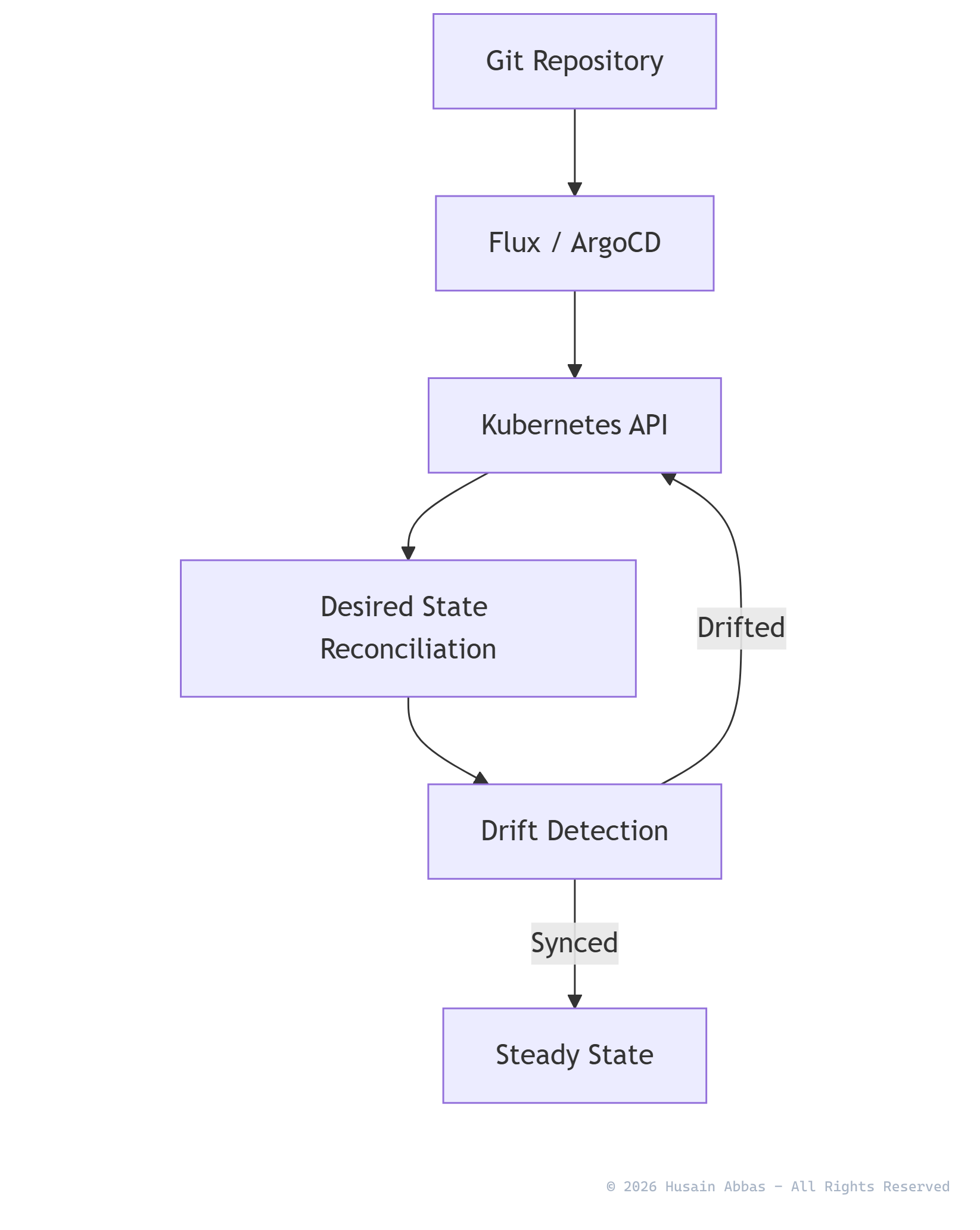
Instead of a CI/CD pipeline “pushing” changes into a cluster, a GitOps Controller (like ArgoCD or Flux) runs inside the environment.
- Declarative State: All infrastructure is defined as declarative code (YAML, Terraform) and committed to Git.
- Continuous Pull: The GitOps controller continuously polls the Git repository.
- Automated Reconciliation: If the live environment drifts from the Git state (due to a manual change or a malicious attack), the controller immediately detects the drift and overwrites the live environment to match Git.
Core Implementation
Implementing GitOps requires shifting from imperative commands (kubectl apply) to declarative synchronization. Below is an example of an ArgoCD Application custom resource. It tells ArgoCD to monitor a specific Git repository and synchronize its contents into the local Kubernetes cluster.
# ArgoCD Declarative Application Definition
apiVersion: argoproj.io/v1alpha1
kind: Application
metadata:
  name: enterprise-payment-service
  namespace: argocd
spec:
  # The Source of Truth: Where the declarative infrastructure lives
  source:
    repoURL: 'https://github.com/enterprise/infrastructure-manifests.git'
    path: 'clusters/production/payment-service'
    targetRevision: HEAD

  # The Destination: Where the infrastructure should be deployed
  destination:
    server: 'https://kubernetes.default.svc'
    namespace: payments-prod

  # The Reconciliation Engine configuration
  syncPolicy:
    automated:
      # Automatically deploy changes when Git is updated
      prune: true
      # Automatically revert manual "ClickOps" changes in the live cluster
      selfHeal: true
    syncOptions:
    - CreateNamespace=true
Edge Cases & Limitations
While GitOps provides incredible consistency, it introduces unique challenges:
- Secret Management: You cannot commit plaintext API keys or database passwords into a Git repository. GitOps requires complex secondary architectures (like HashiCorp Vault or SealedSecrets) to securely inject secrets at runtime without exposing them in code.
- The “Self-Heal” Outage: If a critical bug is deployed via Git, an engineer might try to manually delete the failing pod to buy time. If
selfHealis enabled, ArgoCD will instantly recreate the failing pod because it exists in Git. Engineers must be trained to fix issues in Git, not in the cluster. - Multi-Cluster Scaling: Managing a single cluster with GitOps is straightforward. Managing 50 global edge clusters requires a highly complex “App of Apps” or ApplicationSet pattern to avoid massive code duplication in your Git repository.
Recommended Industry Reading & References
For further exploration of GitOps, hyperautomation, and infrastructure as code, consider these authentic resources:
- Weaveworks: Guide to GitOps - Foundational concepts from the creators of the term “GitOps”.
- Argo Project: ArgoCD Documentation - The definitive guide to declarative, GitOps continuous delivery for Kubernetes.
- HashiCorp: Infrastructure as Code in a CI/CD Pipeline - Best practices for automating infrastructure provisioning.
- CNCF: GitOps Working Group - The open standards body defining the principles of GitOps.