March 8, 2026
Multi-Cloud FinOps: Architecting for Zero-Waste Azure and AWS Deployments
How to engineer deterministic cost controls, enforce multi-cloud FinOps governance, and eliminate cloud waste at the infrastructure level.
The Problem
As enterprise cloud footprints expand across AWS, Azure, and GCP, cloud spend rapidly spirals out of control. Developers with raw access to cloud consoles or overly permissive CI/CD pipelines can spin up massive compute clusters and abandon them. Traditional “cloud cost management” is purely reactive—finance teams receive a massive bill at the end of the month and scramble to figure out who provisioned what. The fundamental problem is a lack of shift-left architectural cost governance.
The Architectural Solution
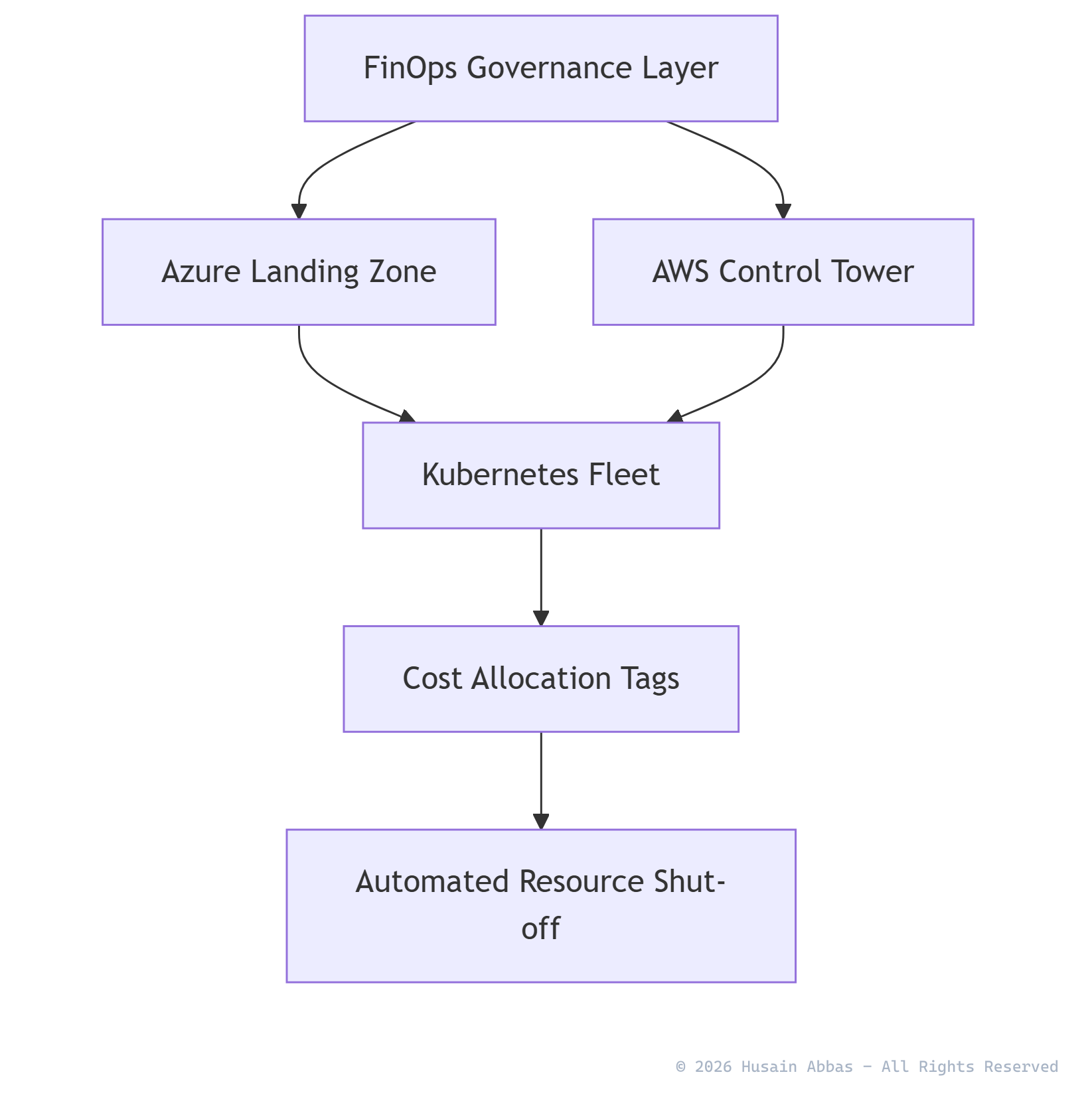
The solution is a mature Engineering-Led FinOps Architecture. Rather than waiting for a bill, cost governance is baked directly into the infrastructure deployment pipeline.
- Tagging Enforcement: No infrastructure can be deployed without strict
CostCenter,Owner, andEnvironmenttags. - Automated Budget Guardrails: Infrastructure as Code (IaC) runs through a cost-estimation phase (e.g., Infracost) during the Pull Request. If the PR exceeds a predefined budget increase threshold, it is automatically blocked and requires VP approval.
- Ephemeral Environments: Development and staging environments are automatically torn down during non-business hours via serverless chron jobs, eliminating idle waste.
Core Implementation
The most critical component of FinOps architecture is strict tagging. If a resource cannot be attributed, its cost cannot be managed. Below is an example of using HashiCorp Terraform alongside AWS Default Tags to guarantee 100% compliance across a project.
# Terraform: Enforcing Global FinOps Tags across an AWS Provider
provider "aws" {
  region = "us-east-1"

  # Default tags are automatically applied to EVERY resource created by this provider.
  # This prevents developers from forgetting to tag individual databases or EC2 instances.
  default_tags {
    tags = {
      Environment = var.environment
      CostCenter  = "AI-Platform-0992"
      Owner       = "[email protected]"
      ManagedBy   = "Terraform"
      # Critical for Automated Tear-Down scripts
      Ephemeral   = var.environment == "prod" ? "false" : "true"
    }
  }
}

# Example Resource: Even without explicit tags here, it inherits the FinOps tags.
resource "aws_rds_cluster" "ai_feature_store" {
  cluster_identifier = "ai-feature-store-${var.environment}"
  engine            = "aurora-postgresql"
  engine_mode       = "serverless"

  # Scaling parameters bounded to prevent runaway serverless costs
  scaling_configuration {
    auto_pause               = true
    max_capacity             = var.environment == "prod" ? 64 : 4
    min_capacity             = 2
    seconds_until_auto_pause = 300
  }
}
Edge Cases & Limitations
While automated FinOps controls reduce waste, they come with caveats:
- Shared Resources: Kubernetes clusters, shared Kafka event buses, and unified network egress hubs are notoriously difficult to attribute to a single
CostCenter. This requires complex chargeback models using agent-based telemetry (like Kubecost). - Developer Friction: Blocking Pull Requests based on estimated cloud costs can severely slow down development velocity if the threshold rules are too strict or if the cost estimation tool hallucinates an inaccurate price.
- Data Transfer Costs: Terraform and IaC cost estimators are generally blind to usage-based metrics like network egress. You may approve a $50/month EC2 instance that ends up generating $5,000/month in unexpected data transfer fees.
Recommended Industry Reading & References
For further exploration of FinOps, multi-cloud architectures, and cost governance, consider these authentic resources:
- FinOps Foundation: FinOps Framework - The definitive operating model for cloud financial management.
- Azure Architecture Center: Cloud Adoption Framework - Cost Governance - Microsoft’s official guide to enterprise cost control.
- AWS Well-Architected Framework: Cost Optimization Pillar - Foundational principles for engineering cost-efficient systems on AWS.
- Cloud Native Computing Foundation (CNCF): Cloud Native FinOps - Standards for aligning Kubernetes orchestration with cost allocation.