November 22, 2025
Shift-Left Compliance: Automating Security Governance in CI/CD
How to decouple security reviews from human bottlenecks by injecting automated Policy-as-Code checks directly into the developer pipeline.
The Problem
In highly regulated environments (e.g., healthcare, finance), infrastructure deployments are often gated by manual security reviews and compliance audits. This creates a severe bottleneck. Developers write infrastructure code, wait weeks for a security committee to approve it, and are then forced to rewrite it when a violation is found. This “bolt-on” security approach destroys development velocity, leads to shadow IT, and increases the likelihood of human error during manual audits.
The Architectural Solution
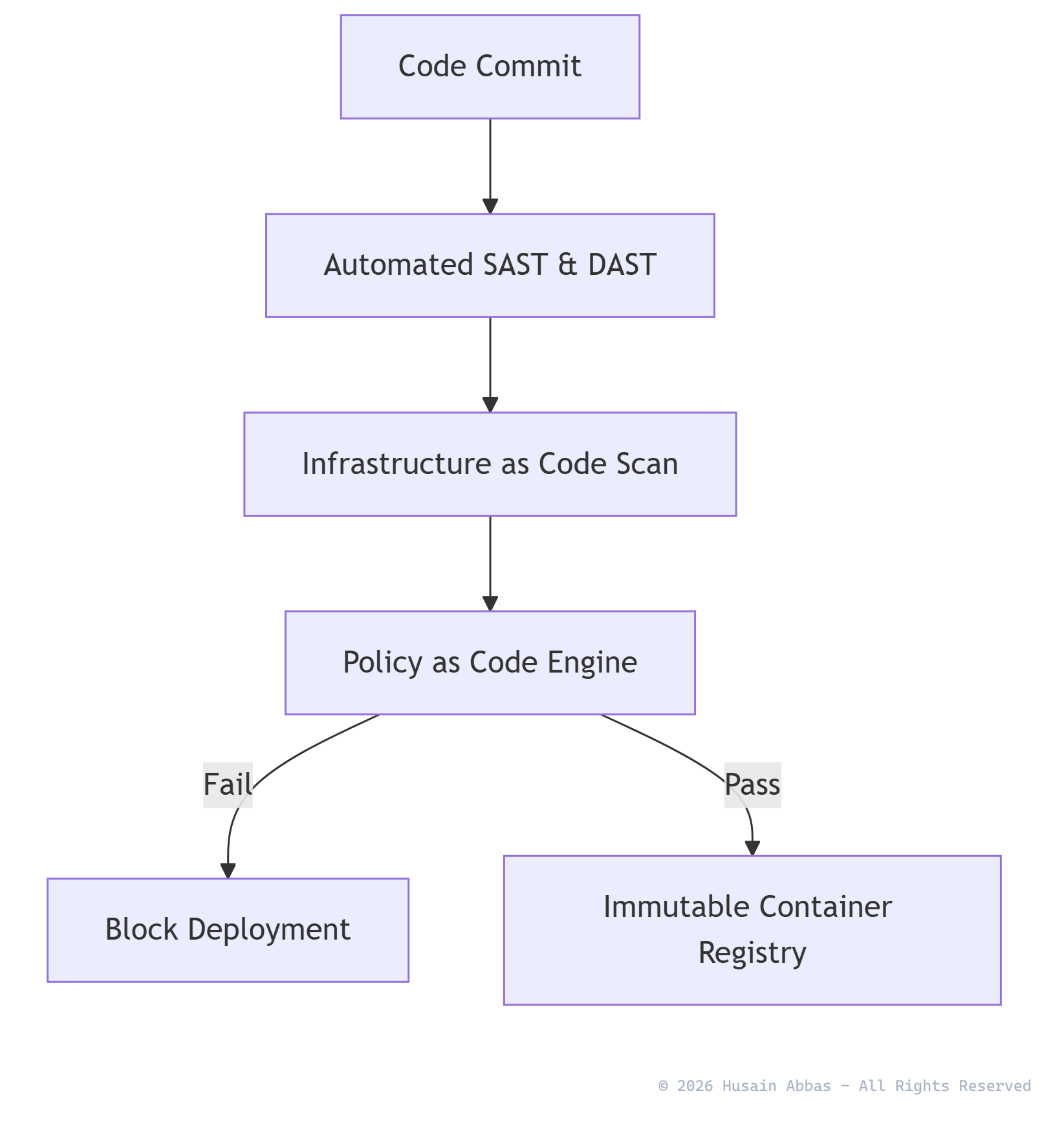
The solution is Policy-as-Code (PaC) integrated directly into the CI/CD pipeline, fundamentally enforcing a “Shift-Left” security model.
Instead of a human reading Terraform code to check if an S3 bucket is public, a policy engine (like Open Policy Agent or HashiCorp Sentinel) statically analyzes the code on every Pull Request.
- Local Authoring: Developers write infrastructure code.
- Pre-Commit Enforcement: Automated policies evaluate the code against enterprise compliance rules (e.g., PCI-DSS, SOC2).
- Automated Blocking: If a violation is detected (e.g., missing encryption), the PR is automatically blocked with explicit instructions on how to fix it, completely eliminating the human review bottleneck for known rules.
Core Implementation
Open Policy Agent (OPA) utilizes a declarative language called Rego to define policies. Below is an example of an OPA policy that automatically blocks any AWS S3 bucket from being provisioned without server-side encryption enabled.
# OPA Policy: Enforce S3 Bucket Encryption
package terraform.aws.s3_encryption

# Default to denying the deployment
default allow = false

# Allow deployment only if the bucket is encrypted
allow {
    not unencrypted_buckets
}

# Find any bucket that is missing the server_side_encryption_configuration block
unencrypted_buckets {
    # Iterate over all resources in the Terraform plan
    resource := input.resource_changes[_]

    # Check if the resource is an AWS S3 bucket
    resource.type == "aws_s3_bucket"

    # Check if it is being created or updated
    action := resource.change.actions[_]
    action == ["create", "update"][_]

    # Violation: The encryption block does not exist
    not resource.change.after.server_side_encryption_configuration
}

# Provide the developer with a clear error message in their CI pipeline
deny[msg] {
    unencrypted_buckets
    msg := "SECURITY VIOLATION: All S3 buckets must have server_side_encryption_configuration enabled to comply with SOC2 requirements."
}
Edge Cases & Limitations
While Policy-as-Code accelerates compliance, it is not a silver bullet:
- Context-Blindness: Statically analyzing Infrastructure-as-Code cannot evaluate runtime context. An OPA policy might verify a firewall rule is syntactically correct, but it cannot know if that IP range was hijacked.
- Developer Fatigue: If policies are too restrictive or poorly written, developers will be bombarded with false-positive blocks in their CI/CD pipelines, leading to frustration and attempts to bypass the system.
- Legacy Infrastructure Drift: PaC only governs new code flowing through the pipeline. If a cloud administrator manually modifies an S3 bucket in the AWS Console (ClickOps), the PaC system is completely unaware. This requires a secondary drift-detection system (like AWS Config) to remediate runtime drift.
Recommended Industry Reading & References
For further exploration of DevSecOps, shift-left automation, and compliance as code, consider these authentic resources:
- Open Policy Agent (OPA): Policy-based Control for Cloud Native Environments - The industry standard engine for Policy as Code (PaC).
- OWASP: DevSecOps Guideline - The definitive framework for integrating security into the CI/CD pipeline.
- AICPA: SOC 2 Compliance Requirements - The authoritative source for managing customer data based on five “trust service principles”.
- NIST: Secure Software Development Framework (SSDF) - Federal guidelines for mitigating the risk of software vulnerabilities.