February 15, 2026
Architectural Patterns for Zero-Downtime Legacy Migrations
How to decouple legacy monoliths and execute zero-downtime database migrations using Change Data Capture and Blue/Green deployment models.
The Problem
Enterprise architectures often suffer from the “Database Monolith” anti-pattern, where dozens of different applications are tightly coupled to a single, massive relational database. When attempting to migrate to a modernized cloud environment, moving this massive database implies taking the entire business offline for hours (or days) while terabytes of data are copied over. In 24/7 global operations, this downtime is unacceptable. The problem is how to seamlessly migrate live, actively mutating data from a legacy on-premise system to the cloud without dropping a single transaction.
The Architectural Solution
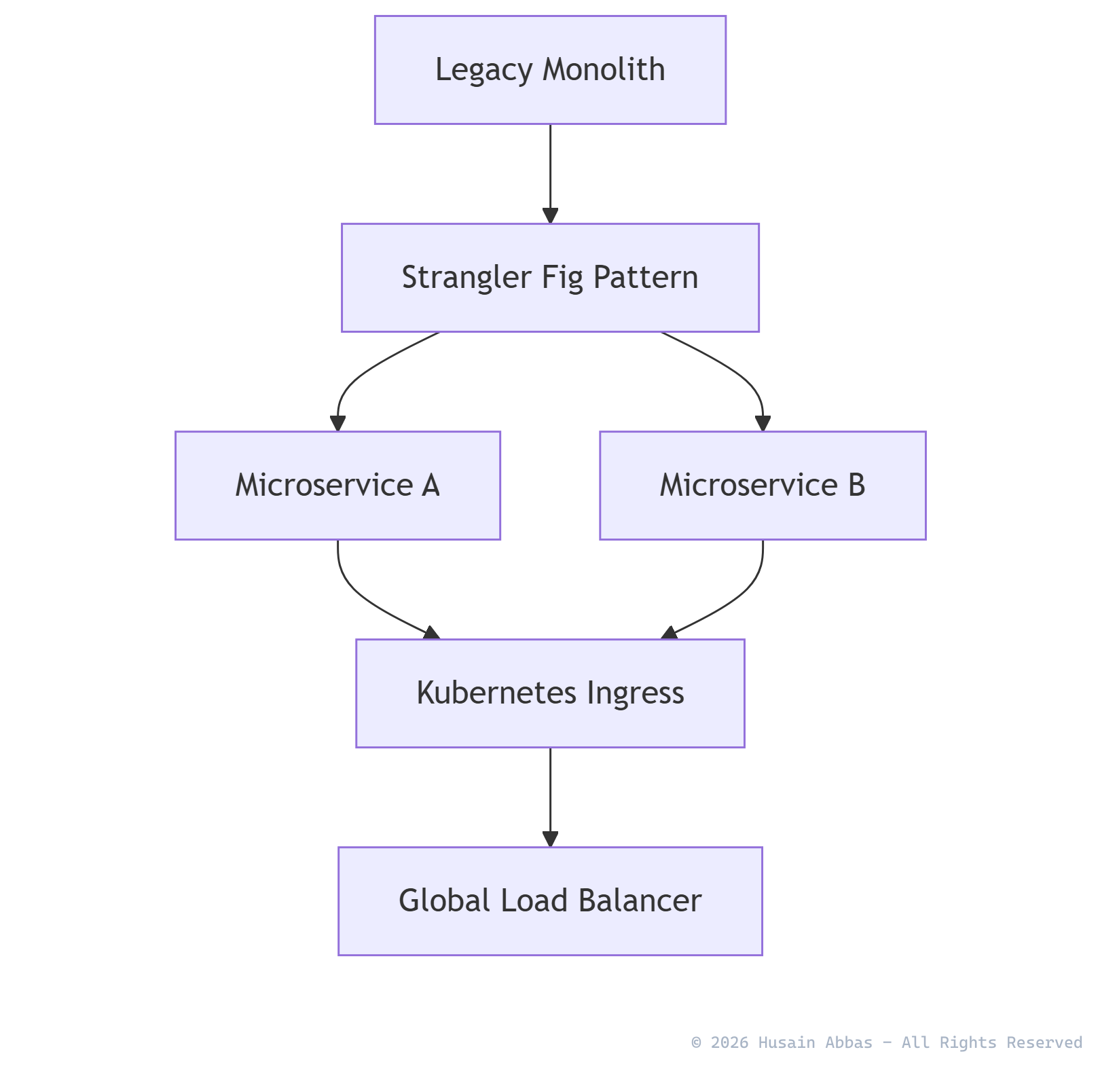
The architectural gold standard for this scenario is Change Data Capture (CDC) combined with the Strangler Fig Pattern.
Instead of taking the database offline, a CDC agent reads the legacy database’s internal transaction logs (e.g., PostgreSQL WAL or Oracle Redo Logs) in real-time. An initial snapshot is moved to the cloud, and the CDC pipeline streams every subsequent INSERT, UPDATE, and DELETE into the new cloud database, keeping them in perfect sync.
- Snapshot + Sync: The cloud database catches up to the live legacy database.
- Dual Writes: The application writes to both databases to verify schema compatibility.
- Traffic Cutover: A global load balancer immediately points all read/write traffic to the new cloud endpoint. Downtime is measured in milliseconds.
Core Implementation
Implementing a CDC pipeline often relies on open-source frameworks like Debezium paired with Apache Kafka to guarantee event delivery. Below is a conceptual configuration for deploying a Debezium source connector against a legacy PostgreSQL database.
// Debezium PostgreSQL CDC Connector Configuration
{
  "name": "legacy-inventory-connector",
  "config": {
    "connector.class": "io.debezium.connector.postgresql.PostgresConnector",
    "database.hostname": "onprem-db.enterprise.internal",
    "database.port": "5432",
    "database.user": "cdc_admin",
    "database.password": "secure_password",
    "database.dbname": "legacy_monolith",
    "database.server.name": "inventory_cluster",

    // Whitelist only the tables that belong to the microservice we are migrating
    "table.include.list": "public.products, public.stock_levels",

    // Utilize the pgoutput plugin to parse the Write-Ahead Log (WAL)
    "plugin.name": "pgoutput",

    // Automatically capture schema changes alongside data changes
    "include.schema.changes": "true",

    // Route CDC events to the highly available Kafka topic
    "database.history.kafka.topic": "schema-changes.inventory",
    "database.history.kafka.bootstrap.servers": "kafka.cloud-native.svc:9092"
  }
}
Edge Cases & Limitations
While CDC enables zero-downtime migrations, it is a highly volatile engineering pattern:
- Transaction Log Overhead: CDC agents consume CPU and disk I/O on the legacy database. If the legacy database is already running at 99% CPU utilization, attaching a CDC reader can crash the primary node.
- Eventual Consistency Latency: If the network link between the on-premise data center and the cloud drops, the replication lag spikes. A cutover cannot happen until replication lag reaches zero.
- Data Type Mismatches: Moving from Oracle to Cloud PostgreSQL via CDC requires translating proprietary data types (like Oracle
BLOBorNUMBER(38)) on the fly, which often results in silent truncation if not handled via a robust stream processing engine.
Recommended Industry Reading & References
For further exploration of zero-downtime migrations and legacy modernization, consider these authentic resources:
- Martin Fowler: Strangler Fig Application Pattern - The foundational blueprint for safely deprecating legacy monoliths.
- AWS Architecture Center: Migration Strategy: 6 R’s - The definitive enterprise migration strategy framework.
- Google Cloud Architecture: Database Migration Concepts - Advanced patterns for migrating high-liability data without downtime.
- Kubernetes Documentation: Rolling Updates and Deployments - Official documentation on ensuring zero-downtime container rollout.