September 6, 2025
Zero-Trust Kubernetes: Architecting Micro-Segmented Security Boundaries
How to eliminate implicit trust inside Kubernetes clusters by engineering strict pod-to-pod network policies, mTLS, and RBAC controls.
The Problem
By default, Kubernetes is designed for extreme developer velocity, which means its default security posture is entirely open. Any pod inside a standard Kubernetes cluster can communicate with any other pod over the internal network without restriction. If an attacker breaches a single low-priority container (e.g., a vulnerable frontend web server), they can immediately pivot laterally across the cluster’s internal network to attack high-liability backend databases or payment processing APIs. Implicit trust is the root cause of lateral compromise.
The Architectural Solution
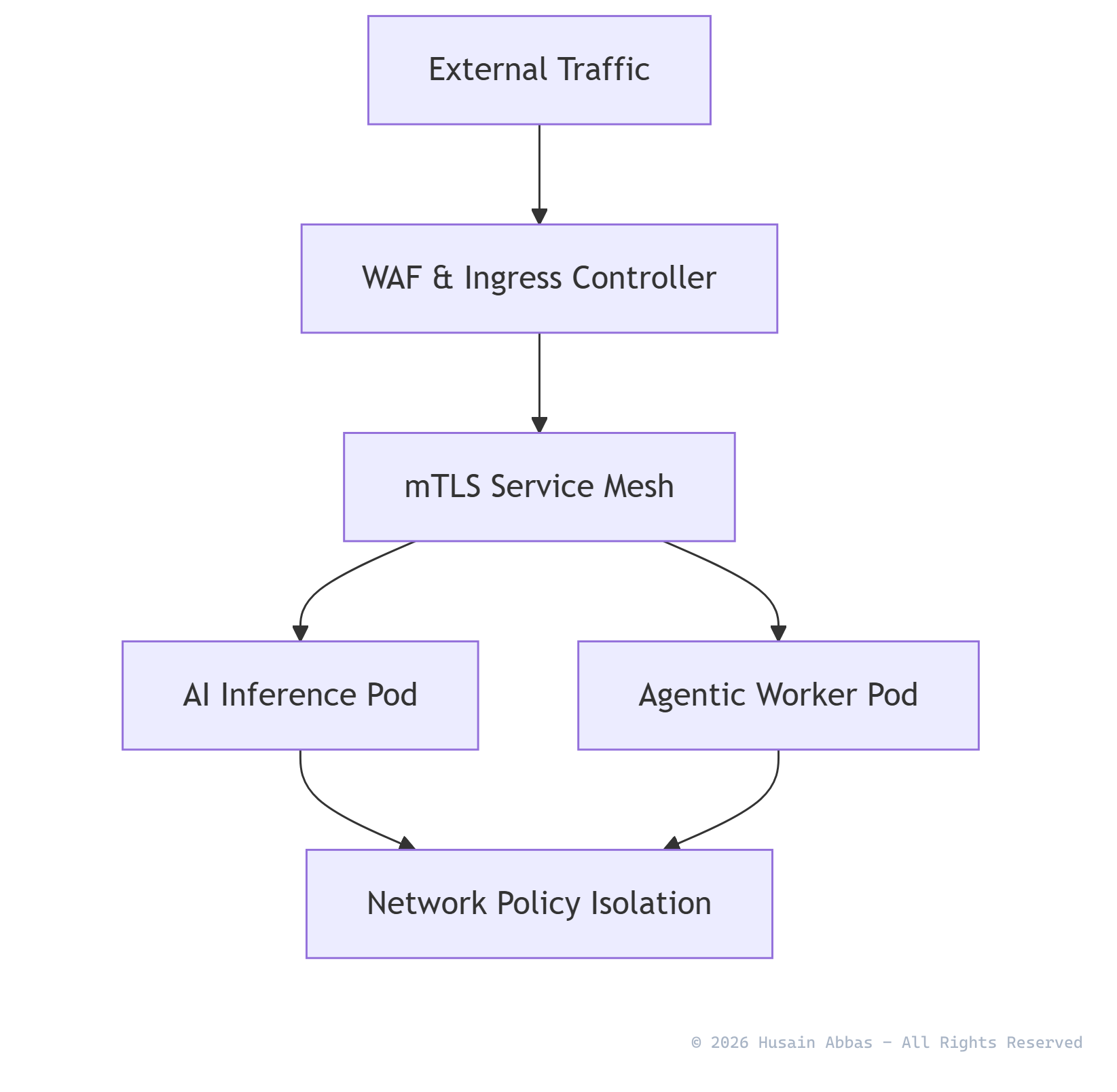
The solution is a true Zero-Trust Architecture built on micro-segmentation. In a zero-trust cluster, every single network connection must be explicitly authorized, authenticated, and encrypted, regardless of whether the traffic is originating from inside the cluster.
- Network Policies: Firewalls are moved from the perimeter down to the individual Pod level. A strict “Default Deny” policy drops all traffic, and explicit “Allow” rules are required for pods to communicate.
- Mutual TLS (mTLS): A Service Mesh (like Istio or Linkerd) injects sidecar proxies into every pod to encrypt all pod-to-pod traffic via mTLS, verifying the cryptographic identity of both the sender and the receiver.
- Least Privilege RBAC: Applications are bound to specific Kubernetes Service Accounts with severely restricted permissions, preventing them from querying the Kubernetes API server maliciously.
Core Implementation
The foundation of Zero Trust in Kubernetes is the “Default Deny” network policy. Until this is applied, your cluster is implicitly open. Below is the Kubernetes YAML required to lock down a namespace completely, followed by an explicit rule allowing the frontend to talk to the backend.
# Step 1: Default Deny All Ingress/Egress in the Namespace
apiVersion: networking.k8s.io/v1
kind: NetworkPolicy
metadata:
  name: default-deny-all
  namespace: secure-production
spec:
  podSelector: {} # Selects ALL pods in the namespace
  policyTypes:
  - Ingress
  - Egress
  # By providing no ingress/egress rules here, ALL traffic is dropped.

---

# Step 2: Explicitly Allow Frontend to communicate with Backend Database
apiVersion: networking.k8s.io/v1
kind: NetworkPolicy
metadata:
  name: allow-frontend-to-db
  namespace: secure-production
spec:
  # This policy applies ONLY to the backend database pods
  podSelector:
    matchLabels:
      app: backend-database
  policyTypes:
  - Ingress
  ingress:
  - from:
    # Only allow traffic originating from pods labeled as frontend
    - podSelector:
        matchLabels:
          app: frontend-web
    ports:
    # Only allow traffic on the specific database port (e.g., PostgreSQL)
    - protocol: TCP
      port: 5432
Edge Cases & Limitations
Enforcing strict Zero-Trust introduces several operational complexities:
- Debugging Nightmares: When a default-deny policy is enforced, simple commands like
curlorpingbetween pods stop working. Without advanced service mesh observability tooling, debugging why two microservices cannot communicate becomes exponentially harder. - Service Mesh Overhead: Injecting a sidecar proxy into every single pod to enforce mTLS adds a non-trivial amount of CPU, memory, and network latency overhead. For ultra-high-throughput, low-latency streaming applications, this overhead might be unacceptable.
- DNS Failures: A strict egress default-deny policy will block pods from communicating with the cluster’s CoreDNS server. Engineers frequently lock down egress and accidentally break internal DNS resolution entirely, bringing down their applications.
Recommended Industry Reading & References
For further exploration of zero-trust architectures and Kubernetes security, consider these authentic resources:
- NIST: Zero Trust Architecture (SP 800-207) - The foundational federal blueprint for implementing zero-trust concepts.
- Cloud Native Computing Foundation: Cloud Native Security Whitepaper - A comprehensive guide to defending Kubernetes ecosystems.
- Istio Documentation: Security & mTLS - The gold standard for establishing mutual TLS and zero-trust service mesh networking.
- OWASP: Kubernetes Security Cheat Sheet - Actionable best practices for locking down cluster RBAC and network policies.