July 18, 2026
Strategic Enterprise Modernization: From Legacy to Cloud-Native AI
A framework for safely strangling legacy monoliths, establishing zero-downtime routing, and paving the way for cloud-native applied AI.
The Problem
Enterprise organizations are burdened by decades-old monolithic applications that are highly coupled, fragile, and impossible to scale dynamically. When these organizations attempt to adopt cutting-edge Applied AI or modern microservices, they find themselves blocked by their own foundation. Attempting a “Big Bang” rewrite of a critical legacy system almost universally ends in catastrophic failure, budget overruns, and severe operational downtime. The challenge is how to modernize the engine of an airplane while it is mid-flight.
The Architectural Solution
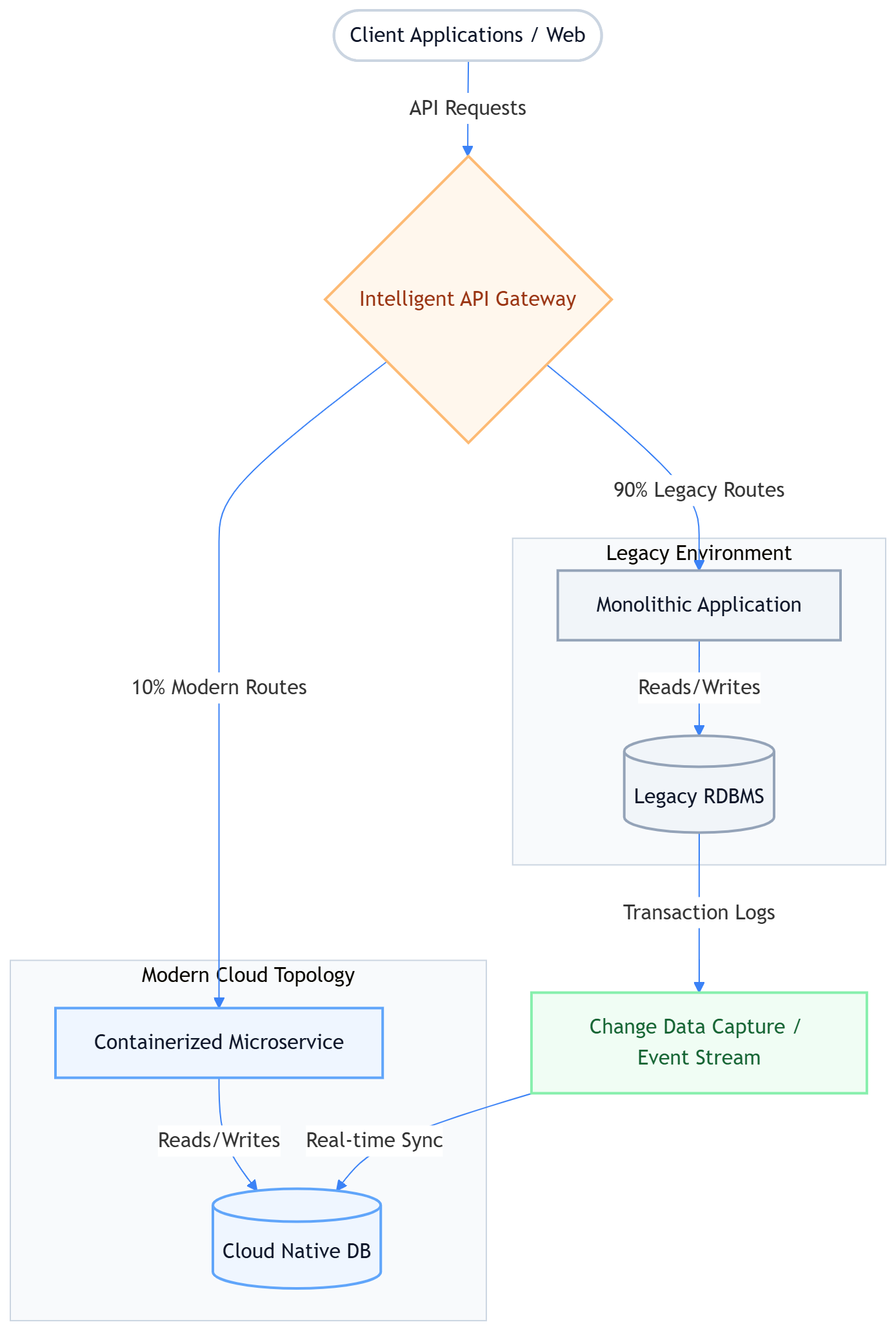
The most effective approach is the Strangler Fig Pattern combined with Intelligent Layer 7 Routing. Instead of rewriting the application all at once, new features (or specific high-liability domains) are carved out and built as modern, cloud-native microservices.
An API Gateway or Service Mesh is placed in front of both the legacy system and the new microservices. Traffic is selectively routed based on URI paths, headers, or user cohorts. Over time, as more functionality is migrated to the new architecture, the legacy system is “strangled” until it can be safely decommissioned.
Core Implementation
The heart of this architecture relies on intelligent, programmable edge routing. Below is an example of how an Envoy-based API Gateway (such as Istio or Kong) might be configured using declarative YAML to route specific API traffic away from the monolith.
# Edge Gateway Routing Configuration (Istio VirtualService Example)
apiVersion: networking.istio.io/v1alpha3
kind: VirtualService
metadata:
  name: enterprise-api-router
spec:
  hosts:
  - "api.enterprise.com"
  http:
  # Step 1: Route the modernized 'AI Recommendations' domain to the new microservice
  - match:
    - uri:
        prefix: "/v2/recommendations"
    route:
    - destination:
        host: ai-recommendation-service.modern-namespace.svc.cluster.local
        port:
          number: 8080

  # Step 2: Implement a Canary Release for the 'Checkout' domain
  # 10% of traffic goes to the new modernized checkout, 90% stays on legacy.
  - match:
    - uri:
        prefix: "/v1/checkout"
    route:
    - destination:
        host: modernized-checkout.modern-namespace.svc.cluster.local
      weight: 10
    - destination:
        host: legacy-monolith.legacy-namespace.svc.cluster.local
      weight: 90

  # Step 3: Default Fallback (The Strangler Fig Base)
  # All other un-modernized routes fall back to the legacy system
  - route:
    - destination:
        host: legacy-monolith.legacy-namespace.svc.cluster.local
        port:
          number: 80
Edge Cases & Limitations
While the Strangler Fig pattern reduces deployment risk, it introduces significant data complexity:
- Database Entanglement: If the modernized microservice and the legacy monolith still need to read/write to the exact same underlying legacy database tables, you will encounter race conditions and locking issues. Data must be decoupled alongside the code (often utilizing Change Data Capture patterns).
- Distributed Transactions: Legacy systems often rely on ACID transactions across multiple domains. When these domains are split into distributed microservices, those atomic transactions must be rewritten as complex Saga patterns.
- Session Management: If a user navigates between a legacy page and a modernized page, their authentication state must be seamlessly shared. This often requires migrating off legacy sticky-sessions and implementing stateless JWTs before the migration can even begin.
Key Strategic Takeaways
- Never Attempt Big Bang Rewrites: Carve out high-value, bounded domain contexts and incrementally redirect production traffic via Layer 7 routing.
- Decouple Data in Parallel: Code modernization without database isolation creates distributed monoliths. Leverage CDC and asynchronous event streams to synchronize data stores.
- Canary Everything: Use weight-based ingress routing (e.g., 95/5 traffic splits) with automated telemetry rollback to de-risk production cutovers.
Recommended Industry Reading & References
For further exploration of legacy modernization and cloud-native patterns, consider these authentic resources:
- Martin Fowler: Strangler Fig Application - The foundational essay defining this exact modernization pattern.
- AWS Prescriptive Guidance: Decompose monoliths into microservices - Strategic methodologies for breaking down legacy systems.
- Sam Newman: Monolith to Microservices - The definitive textbook on migration patterns and data decoupling.
- Envoy Proxy: Life of a Request - Deep dive into how modern edge proxies handle L7 routing and traffic splitting.